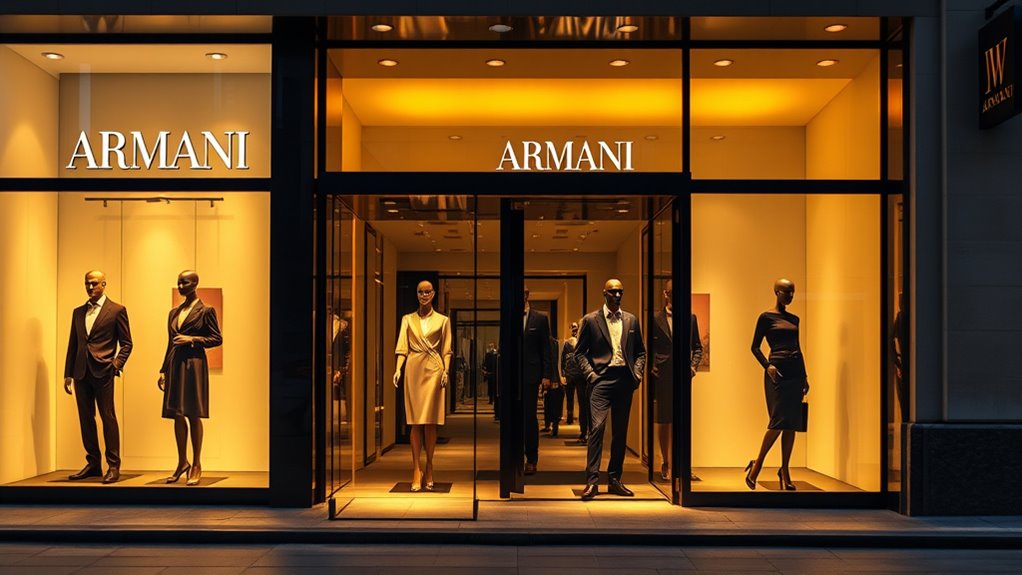

Armani had a strong year, surpassing €4.25 billion in total revenues despite challenging market conditions. While core luxury segment revenues declined slightly, the brand focused on strategic store renovations, digital investments, and e-commerce expansion to stay resilient. Although overall profits decreased, Armani’s careful management and targeted investments helped maintain its position in the global luxury market. To discover how Armani continues to adapt and thrive, keep exploring the details behind this impressive performance.

Get furniture and decor delivered free — and shop member deals
- Fast, free delivery on millions of items
- Access to Prime Big Deal Days deals on October 6–7
- Prime Video, Amazon Music and more included

Have Armani’s recent efforts turned a challenging year into a sign of resilience? Despite facing a tough economic climate, the Italian fashion house managed to report impressive overall revenues of over €4.25 billion when including licensed beauty and eyewear sales. This achievement showcases the brand’s strategic approach to weathering market downturns and maintaining its global presence. However, on a closer look, the core luxury segment experienced a decline, with consolidated net revenues dropping approximately 5-6% to about €2.3 billion in FY2024. This dip reflects broader industry challenges, particularly a slowdown in the luxury market driven by subdued consumer spending and geopolitical uncertainty. Armani’s revenue decreased by 5% in the last fiscal year, highlighting the impact of recent market conditions. You’ll notice that the decline is particularly evident in the direct retail channel, which fell by 3%. Temporary store closures for renovations and a cautious market environment contributed to this drop. Additionally, demand for Armani’s classic suits waned as consumers shifted toward casualwear, impacting the brand’s traditional fashion sales. The Asian market, especially China, faced weakened demand, pulling down overall revenues from the Asia Pacific region to around 19% of total sales. Despite this, Europe remains the company’s largest market, accounting for nearly half of all revenue, highlighting the brand’s strong foothold in its home continent. Financially, Armani faced some setbacks. The group’s net cash and equivalents shrank from $1.09 billion to $656 million, signaling a reduction in liquidity. Net profit before tax plummeted 66% to €74.5 million from €224.5 million the previous year, and EBITDA decreased by 24% to approximately €398 million. These figures reflect the pressure on margins amid softer sales and cautious consumer behavior. Yet, the company’s resilience is evident in its strategic investments. Armani doubled its annual spending to roughly €332-383 million, focusing on store renovations—particularly flagship locations on Madison Avenue, Milano, Paris—and bolstering its e-commerce infrastructure. These investments were fully self-funded, demonstrating solid balance sheet management despite the revenue pressures. The brand’s digital push is a key part of its strategy, supported by the use of best watering pots to ensure that store plants remain healthy and appealing to customers. Armani brought e-commerce operations in-house to enhance digital capabilities, aiming to capture a larger share of online sales amid a sluggish luxury market. Pricing strategies remained prudent, with restrained increases below inflation to prioritize product quality and customer experience over short-term margins. Overall, Armani’s ability to adapt—through targeted investments, digital expansion, and careful market positioning—has helped it navigate a difficult year. While facing industry-wide challenges, the brand’s strategic resilience ensures it remains a key player on the global luxury stage.
Frequently Asked Questions
How Did Armani Achieve Its Revenue Growth This Year?
You see Armani’s revenue growth through strategic investments and brand strength. By renovating flagship stores and boosting e-commerce, you enhance customer experience and brand prestige. You also focus on quality over discounting, maintaining a stable store network and controlling prices. These efforts, combined with long-term planning and a resilient brand image, help you navigate market softness and sustain revenue, positioning Armani for future growth despite recent challenges.
What Regions Contributed Most to Armani’s Sales Increase?
Europe contributed most to Armani’s sales increase, accounting for about 49% of total revenue in 2024. You see, its stable performance, thanks to flagship stores and strong brand presence, helped offset declines elsewhere. The Americas also played a key role, making up 22%, with resilient demand in the U.S. supporting overall growth. Although Asia Pacific declined, Europe and the Americas mainly drove Armani’s revenue rise this year.
How Does Armani Plan to Sustain Its Growth Moving Forward?
You need to stay ahead of the curve by focusing on strategic investments and digital expansion. Armani plans to renovate flagship stores, boost e-commerce, and blend heritage with modern trends. Diversifying markets, exploring portfolio sales, and attracting strategic partners will fuel growth. By balancing innovation with tradition, you’ll guarantee Armani remains resilient amid market shifts, proving that sometimes, you have to think outside the box to secure a bright future.
Were There Any Significant Challenges Faced During the Year?
Yes, you faced significant challenges this year, including a global slowdown in fashion and luxury markets, which led to a 5-6% revenue decline. Geopolitical tensions and economic uncertainty affected consumer confidence, while store closures and restructuring impacted sales. Despite these obstacles, you invested heavily in flagship renovations and e-commerce, aiming for long-term growth. The passing of Giorgio Armani also posed strategic and leadership hurdles, requiring careful succession planning.
How Does Armani’s Revenue Compare to Its Main Competitors?
You see, Armani’s €4.25 billion looks impressive until you realize LVMH’s €75 billion or Hermès’ €15 billion dwarf it. Prada nearly matches it, but Chanel and Gucci? They’re in a different league entirely. So, while Armani holds a respectable spot, your main competitors simply play in a much bigger sandbox with deeper pockets, wider reach, and more integrated operations—making Armani’s revenue more of a respectable size than a giant.
As an affiliate, we earn on qualifying purchases.
Conclusion
This year, Armani proves that success isn’t just a fleeting shadow but a shining beacon guiding your ambitions. With over €4.25 billion in revenue, it’s clear that your dedication and vision can turn dreams into reality. As the brand soars to new heights, remember that every great achievement begins with bold steps. So, take inspiration from Armani’s journey, and know that your own path to greatness awaits—just beyond the horizon of possibility.
As an affiliate, we earn on qualifying purchases.
high-end e-commerce fashion accessories
As an affiliate, we earn on qualifying purchases.
As an affiliate, we earn on qualifying purchases.
As an affiliate, we earn on qualifying purchases.
Halloween Picks
halloween
As an affiliate, we earn on qualifying purchases.