TL;DR

Get furniture and decor delivered free — and shop member deals
- Fast, free delivery on millions of items
- Access to Prime Big Deal Days deals on October 6–7
- Prime Video, Amazon Music and more included
Hunker describes a simple Halloween craft that uses paper doilies, cotton balls, thread and ribbon to make a ghost garland. The ghosts can be personalized with drawn faces, pastel doilies or small accessories; the source provides craft instructions, not a tested product review or reported trend.
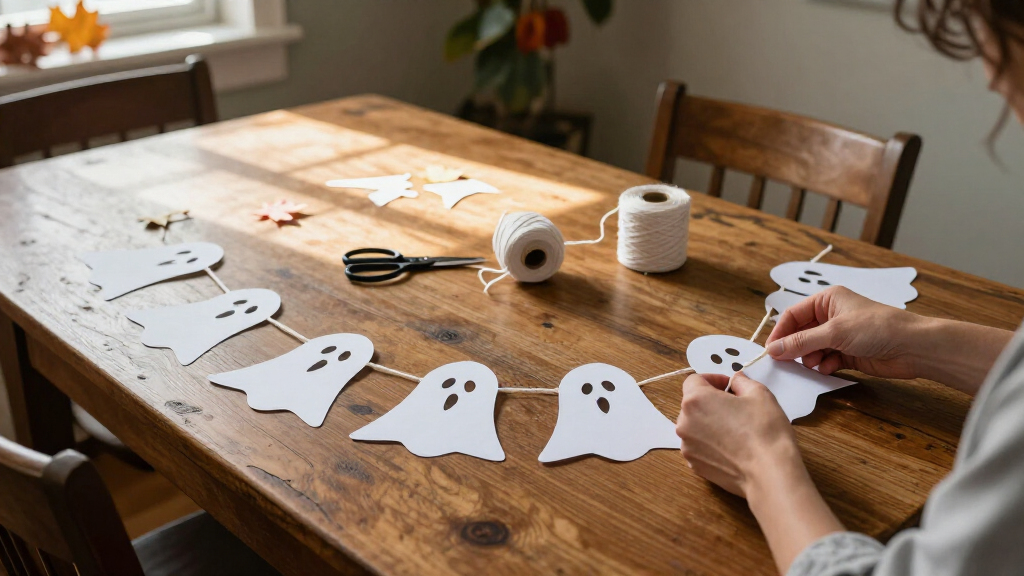
Hunker has published a do-it-yourself Halloween craft that turns paper doilies and cotton balls into a lightweight ghost garland, offering readers a way to make seasonal decorations from a short list of craft supplies. The guide outlines how to shape, decorate and thread the ghosts, with options for giving the finished strand a vintage-inspired look.
The materials listed are paper doilies, cotton balls, thread or string, ribbon, a black marker, scissors and a large sewing needle. The instructions begin by measuring the place where the garland will hang and cutting the thread slightly longer than that span, leaving extra length at both ends.
To form each ghost, place a cotton ball in the center of a doily and gather the paper around it to make a rounded head. Pinch the paper below the head and tie it with a narrow ribbon or string. Hunker suggests using two doilies per ghost if one layer appears too transparent, and tying a small bow to help hold the shape without tearing the paper.
After shaping the figures, makers can draw eyes and mouths with a marker or leave the faces blank. The guide says to thread the garland string carefully through each cotton-filled head and tie a knot after each ghost to keep it in place. Suggested embellishments include pastel-colored doilies, tiny bows, lightweight paper accessories and beads between the figures.
A Small-Scale Alternative to Store-Bought Decor
The idea gives readers a low-material option for Halloween decorating using items that may already be in a craft drawer. Its practical appeal is the ability to control the number and spacing of ghosts, tailor their expressions and add color or accessories to suit a room.
The finished garland is made from paper and cotton, so it is light and can be stored without taking up much room, though the source also says the decorations can be discarded after the holiday. The guide does not provide a price comparison, durability testing or an environmental assessment; those benefits should not be assumed from the instructions alone.
As an affiliate, we earn on qualifying purchases.
From Doilies to Halloween Decorations
Hunker frames the craft as an alternative to buying new decorations for each holiday, noting that seasonal purchases can add cost and create storage needs. The article presents the garland as a cottage-style or whimsical accent, rather than as a product launch or a report of a wider decorating trend.
The instructions rely on a familiar craft method: gathering paper around a soft center to create a head, then attaching the finished shapes to a line. Personalization is optional. A simple drawn face can be enough, while pastel paper, bows or small lightweight additions create a more decorative effect.
“A pack of paper doilies, for example, can become a dainty ghost garland.”
— Hunker
As an affiliate, we earn on qualifying purchases.
Cost, Strength and Display Conditions
The supplied guide does not state the publication date, materials cost, finished garland length or number of ghosts a typical pack of doilies will produce. It also does not test how well the paper holds up over time or under different indoor conditions.
Hunker advises passing a needle through the cotton-filled heads but does not specify a needle size or provide a separate safety procedure. The paper components may tear if handled roughly, and the source does not say whether the decorations are suitable for outdoor display. Readers should treat these as craft instructions rather than tested performance claims.
As an affiliate, we earn on qualifying purchases.
Make and Hang the Garland
The next step for readers is to measure the intended display area, prepare the thread and decide how many ghosts to make. Once the figures are shaped and decorated, they can be spaced along the line, secured with knots and hung where the paper decorations will remain dry and undisturbed.
Hunker’s guide does not announce a follow-up, a product release or additional testing. Any decisions about storage or disposal are left to the maker; the article says the garland may be saved for another season or discarded after Halloween.
As an affiliate, we earn on qualifying purchases.
Key Questions
What supplies are needed for the paper doily ghost garland?
Hunker lists paper doilies, cotton balls, thread or string, ribbon, a black marker, scissors and a large sewing needle. Optional additions include beads, googly eyes and small paper accessories.
How do you shape each doily into a ghost?
Place a cotton ball in the center of a doily, gather the paper around it to form a head, then tie the paper below the head with a narrow ribbon or string. A second doily can be added if the figure looks too transparent.
Can the ghosts have different faces or decorations?
Yes. The guide suggests drawing eyes and mouths, leaving faces blank, or using pastel doilies and small bows. It also mentions lightweight additions such as paper glasses, hats, bow ties or beads.
Does the guide say how much the project costs or how long it lasts?
No. The supplied article does not give a budget, a completed garland’s dimensions or durability testing. It describes the project as using a few supplies but does not quantify cost or lifespan.
Source: rss
Fall Picks
fall essentials
As an affiliate, we earn on qualifying purchases.