TL;DR

Get furniture and decor delivered free with Prime
- Fast, free delivery on millions of items
- Prime Video, Amazon Music and more included
- Member-only deals all year
A Hunker report describes a home decor craft that uses acorn caps, marbles and strong glue to make jewel-like decorative pieces. The guide recommends sorting, washing, drying and sanitizing the caps before assembly; it does not provide independent testing or a guarantee that the finished pieces will last.
Hunker has published a DIY guide for turning fallen acorn caps and old marbles into small decorative pieces, offering a way to reuse natural and household materials in seasonal displays. The project uses one marble per sturdy cap and strong glue, with finished pieces suggested for baskets, wreaths, garlands and windowsills.
The instructions call for collecting or buying intact acorn caps, then matching them with marbles that fit securely inside. Hunker suggests looking around oak trees in fall, while noting some green acorns may drop during summer. If only whole acorns are available, the cap can be removed by twisting or rotating the nut. The report advises leaving the nuts for wildlife where possible and gathering caps only.
Before assembly, the caps should be sorted and any that are broken or deteriorating discarded. The guide recommends washing them in soapy water, letting them air-dry completely, and then placing them on a foil-lined tray in an oven at about 175 degrees Fahrenheit for one or two hours. Marbles can also be cleaned while the caps are being prepared. The instructions do not cite testing or specify a food-safety standard for this process.
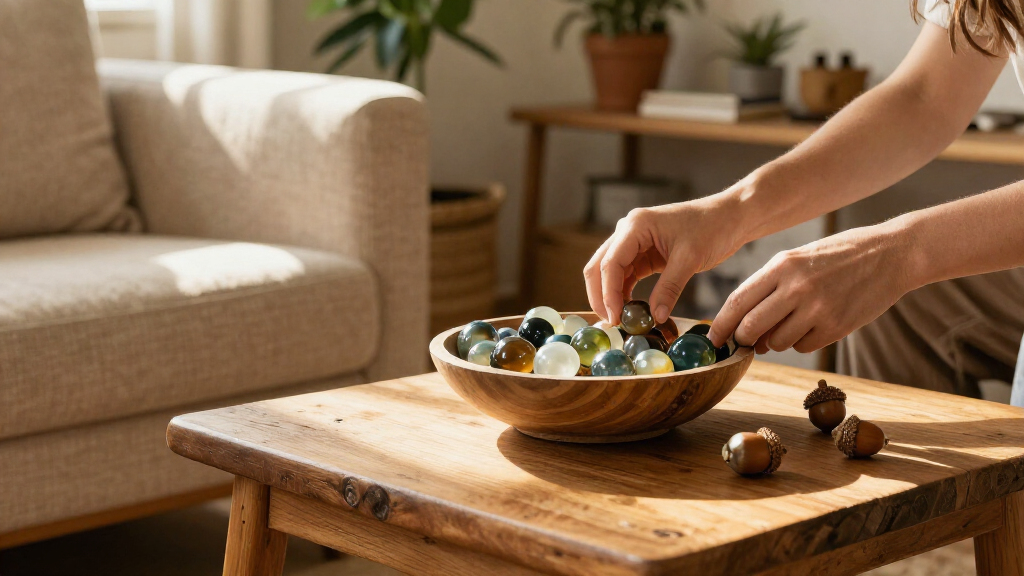
Once the caps are cool, makers can test the fit, apply a small amount of strong glue inside each cap and press in a marble. Hunker cautions against spinning the marble after gluing because glue could smear onto its visible surface or the work area. After the glue dries, the pieces can be displayed loose in a basket or incorporated into decorative items; adding twine is suggested as one way to hang them.
A Small Craft From Fallen Acorns
The project gives readers a low-material way to reuse acorn caps and marbles that might otherwise go unused, while making small accents that can be coordinated with existing decor. It may appeal to people looking for a seasonal activity that does not require specialized tools beyond glue and basic cleaning supplies.
The suggested uses are flexible: a handful of the finished pieces can sit in an entryway basket, while others can be added to wreaths, garlands or suncatchers. Color choice changes the effect, according to the guide: warm red and orange marbles suit a fall display, while translucent or jewel-toned marbles can add color near a window or complement a room’s palette. These are styling suggestions, not tested performance claims.
Products Worth Considering

eufy Security eufyCam C37 4-Camera Kit with 360° Pan and Tilt

Bose TV Speaker Compact Soundbar with Bluetooth and HDMI-ARC, Black

Samsung 42-Inch Class OLED S90F 4K Smart TV (2025)
As an affiliate, we earn on qualifying purchases.
Seasonal Materials and Preparation
Acorns and caps fall from oak trees at different times, and the report says the most general time to search is fall, though some may drop earlier in summer. The availability of suitable caps will vary by location and tree. The guide also notes that caps can be purchased for makers who cannot gather them nearby.
Marbles may be sourced from craft stores, online sellers or thrift shops; the report also suggests making substitutes from clay for those who want another hands-on step. Its central design is simple: the marble replaces the acorn nut, leaving the cap as a small natural-looking frame around a colored center. Hunker presents the project as a decorative craft, rather than a product or a tested method for preserving collected materials.
Durability and Safety Details
The report does not state which glue brands or formulations were tested, how long the pieces take to cure, or how well they withstand humidity, sunlight or repeated handling. It also gives no measurements for cap or marble sizes, so makers will need to check that each marble fits its cap before applying glue.
The suggested oven treatment is described as sanitizing the caps, but the article provides no independent evidence about how effectively it removes pests or eggs. Readers should follow safe oven practices, use a heat-safe tray and allow the caps to cool fully before handling. The finished pieces contain small marbles and may not be suitable where young children or pets could reach them; the report does not discuss child-safety testing or hanging hardware.
Assembly and Display Choices
The next steps for anyone trying the craft are to gather sound caps, clean and fully dry them, choose marbles that sit securely, and follow the glue maker’s directions for application and curing. The pieces should be handled only after the adhesive has dried, then placed or attached in a way appropriate for the intended display. Hunker’s report gives no scheduled follow-up, product test or additional project update.
For the finished look, the guide recommends choosing colors based on where the pieces will appear: warm tones for an autumn basket, translucent marbles for sunlight, or jewel shades that work with existing furnishings. How well a particular set holds together will depend on the materials, fit and adhesive used; that performance is not established in the report.
Key Questions
What materials does the project require?
The basic project needs an equal number of acorn caps and marbles, plus strong glue. The guide also recommends soap and water for cleaning and a foil-lined tray for its suggested oven treatment.
How should acorn caps be prepared?
Sort out broken caps, wash the sturdy ones in soapy water and let them dry completely. Hunker then recommends heating them at about 175 degrees Fahrenheit for one or two hours; the report does not cite testing of that method.
Where can the finished pieces be used?
The guide suggests displaying them in a small basket or adding them to wreaths, garlands or suncatchers. Twine can be attached if the maker wants to hang a piece, although the report does not specify a tested hanging method.
Can any marble fit an acorn cap?
No specific marble size is given. Test each marble in its cap before gluing and choose a combination that sits securely, as the caps and marbles may vary in size.
Source: hunker.com