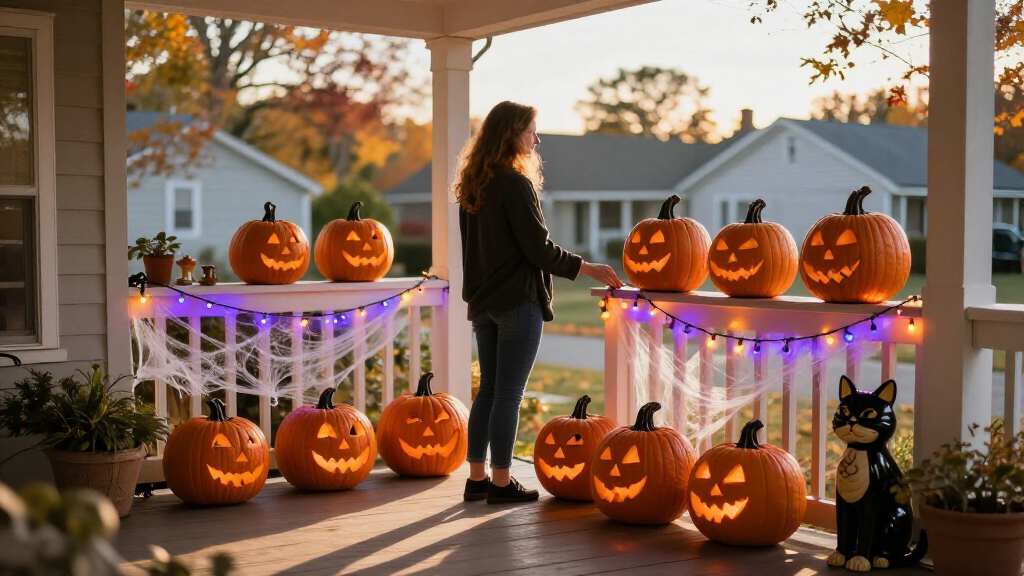
Every October, the same fork appears in the road for Halloween enthusiasts: you can spend a weekend building tombstones out of foam board and rigging ghosts from fishing line, or you can drive to a big-box store, load a cart with a twelve-foot animated reaper, and have a full graveyard scene glowing by dinner time. These two paths — DIY decor versus store-bought props — are what most decorators are really choosing between, and the comparison matters more than it might seem. The wrong choice costs you either a lot of money or a lot of evenings, and neither is refundable.

Get furniture and decor delivered free — and shop member deals
- Fast, free delivery on millions of items
- Access to Prime Big Deal Days deals on October 6–7
- Prime Video, Amazon Music and more included

5-Piece Black Halloween Creepy Cloth, 30 × 72 Inches
- ✔ Color: Black
- ✔ Material: Stretchy cotton
- ✔ Dimensions: 30 × 72 inches per piece

ZPISF Halloween Spider Web Decorations with 150 Fake Spiders
- ✔ Brand: ZPISF
- ✔ Coverage: Up to 1,400 sq ft
- ✔ Web weight: 420 g (14.5 oz)

12-Piece Black Hanging Witch Hat Halloween Decor
- ✔ Quantity: 12 witch hats
- ✔ Material: Black Oxford fabric
- ✔ Cord: 6 mm nylon cord, 328 ft total
The core tension is not simply price versus quality. DIY decor can be stunningly cheap or surprisingly expensive depending on your ambition, and store-bought props range from flimsy dollar-store spiders to several-hundred-dollar animated figures with sound sensors and moving limbs. The real difference is what each path optimizes for: DIY optimizes for originality, scale on a budget, and creative satisfaction, while store-bought optimizes for immediate visual impact, motion and sound effects that are hard to replicate by hand, and reliability you can count on year after year without re-investing effort.
If you love making things, have more time than money, and want a display nobody else on the block will have, DIY is almost certainly your lane. If you want maximum wow-factor with minimal labor, you host trick-or-treaters by the hundred, or you want animatronics that actually move and moan, store-bought is the smarter buy. Most successful home haunts eventually blend both — but this comparison will help you decide where to put the bulk of your budget and effort this season.
At a Glance
| Criteria | DIY Halloween decor | Store-bought Halloween decor (animatronics, inflatables, pre-lit props) | Winner |
|---|---|---|---|
| Upfront cost | $20–$150 in materials; foam, paint, PVC, lights, fabric | $15 for small props; $50–$400+ for inflatables and animatronics | A |
| Scare factor and animation | Static unless you build mechanisms; effects limited by your skills | High — motors, soundtracks, sensors, and synchronized movement out of the box | B |
| Visual originality | Unlimited — your display is genuinely one of a kind | Low to moderate — same reaper and inflatable as every third house | A |
| Setup time and effort | 10–40+ hours of building plus setup; spreads over weeks | 1–4 hours; stake it, plug it in, done | B |
| Durability across seasons | Varies widely; foam and paint can last years if stored carefully | Moderate; mid-range animatronics often fail after 2–4 seasons | Depends |
| Weather resistance | Depends on materials; untreated foam and paper degrade fast in rain | Designed for outdoor use but inflatables and electronics struggle in wind and rain | Depends |
| Storage footprint | Compact; flat-packable and stackable | Bulky; inflatables and large figures eat garage or attic space | A |
| Expandability over the years | Excellent — each year builds on skills and a growing prop pile | Easy to add pieces, but costs scale linearly with each purchase | A |
5-Piece Black Halloween Creepy Cloth, 30 × 72 Inches
Of the three sets, this is the one that changes the mood of a room rather than just adding decorations to it. Each of the five stretchy cotton sheets measures 30 × 72 inches, and because the fabric can be cut or torn without fraying into a mess, you can rag the edges, stretch thin patches, and drape it over curtain rods, mantels, doorways, or porch rails for a genuinely decayed, haunted-house look. Compared with the ZPISF spider web kit, the creepy cloth delivers a darker, heavier aesthetic — webs read as “abandoned,” while black gauze reads as “cursed,” and the two produce very different feelings side by side.The tradeoff is effort and coverage. The web kit stretches across up to 1,400 sq ft with minimal shaping; five cloth panels cover far less area and reward a slower, more deliberate hand. This set makes the most sense for decorators who enjoy the process — tearing, draping, layering — and who want a backdrop that other props sit inside. It also pairs naturally with both other picks in this lineup: webs stretched over black cloth create depth, and a few hanging witch hats above draped fabric completes a room theme. Our one honest caution is durability: the listing gives no material-weight or weather-resistance details, so we would treat this as primarily an indoor set, or plan to bring it in before rain.
Pros:
- Can be cut or torn to customize the haunted look
- Works indoors and outdoors for flexible placement
- Layers well with other Halloween decorations as a backdrop
- Five panels allow multiple rooms or vignettes from one set
Cons:
- No durability or weather-resistance details provided
- Covers far less area than the spider web kit
- Requires manual styling to look intentional rather than sloppy
Best for: Decorators who want layered, moody haunted-house texture and don’t mind hands-on styling
Not ideal for: Anyone covering a large space quickly or decorating a spot that gets rain and wind
Bottom line: The most atmospheric pick here — choose it when you want a room to feel haunted, not just decorated.
“The most atmospheric pick here — choose it when you want a room to feel haunted, not just decorated.”
ZPISF Halloween Spider Web Decorations with 150 Fake Spiders
If the creepy cloth is a crafts project, this kit is a transformation in an afternoon. With 420 g of stretchy white cobweb material rated to cover up to 1,400 sq ft — plus 150 fake spiders to scatter through the strands — this is by far the highest-impact-per-minute option in the lineup. Stretch a wad of webbing across porch columns, bushes, railings, or window frames, add spiders, and the space instantly reads as Halloween. Compared with the 5-piece creepy cloth, the coverage gap is enormous: where the cloth drapes one doorway at a time, the webbing can dress an entire front-of-house display from a single bag.Where it falls behind both other picks is precision and theme. The webs are white, so they brighten a space rather than darken it — a different spooky register than the black gauze — and the look depends on how well you stretch and shape the material. Done lazily, it reads as cotton balls in a bush; done with a few minutes of attention per anchor point, it looks properly sinister. We also appreciate the practical detail that the material is designed for cleanup without damaging furniture, which matters if you are webbing indoors around woodwork and upholstery. For parties, porches, and anyone decorating on a deadline, this is the pick we would reach for first.
Pros:
- Covers up to 1,400 sq ft from a single set
- Includes 150 fake spiders for instant detail
- Stretchable and flexible for shaping around any anchor point
- Designed to clean up without damaging furniture
Cons:
- Requires patient stretching and shaping to avoid a clumpy look
- White coloring gives a brighter, less moody effect than black decor
- Spiders are small and easy to lose during teardown
Best for: Anyone decorating a large porch, yard, or party space quickly and cheaply
Not ideal for: Decorators going for a dark, elegant, or gothic aesthetic — the white webs read playful more than ominous
Bottom line: The best value in sheer coverage — no other option here transforms as much space this fast.
“The best value in sheer coverage — no other option here transforms as much space this fast.”
12-Piece Black Hanging Witch Hat Halloween Decor
This set takes a completely different approach: instead of covering surfaces, it uses vertical space. Twelve 14-inch black Oxford fabric hats hang from an included 328-foot nylon cord, letting you string them across a ceiling, porch, or entryway at varying heights for a floating-silhouette effect. Compared with the other two picks, this is the most deliberately themed option — there is no ambiguity about the motif, which makes it ideal for witch-focused parties or a kid-friendly spooky vibe where the creep factor should stay moderate.Two things set it apart in practical terms. The lightweight Oxford fabric means the hats hold their shape indoors or out without heavy anchors, and they fold flat for compact storage — a genuine advantage over the web kit, which is essentially single-use, and the creepy cloth, which takes more shelf space. The obvious drawback is setup: each hat must be individually threaded onto the cord before hanging, so a full ceiling display takes real time and a ladder. And unlike the webbing’s 1,400 sq ft of coverage, twelve hats decorate one defined zone, not a whole house. As a bonus, the hats double as costume props, which neither competing product can claim — handy if your Halloween plans include both a party and a costume.
Pros:
- Includes 12 hats and 328 feet of cord for large hanging displays
- Lightweight Oxford fabric works indoors and outdoors
- Folds flat for compact off-season storage
- Doubles as costume props unlike the other picks
Cons:
- Hanging requires threading cord through each hat individually
- Decorates one zone rather than covering broad surfaces
- Wind can swing lightweight hats outdoors without secure anchoring
Best for: Hosts who want a bold witch-themed overhead display and reusable, storable decor
Not ideal for: Anyone covering a large area or unwilling to spend time threading and hanging each hat
Bottom line: The most striking single display in the lineup — pick it for a defined space where a witch theme can shine.
“The most striking single display in the lineup — pick it for a defined space where a witch theme can shine.”
As an Amazon Associate we earn from qualifying purchases.
Key Differences
The most consequential difference is what your money and time actually buy. A $150 DIY budget spread across foam tombstones, cheesecloth ghosts, and DIY flood lighting produces a large, cohesive scene that covers an entire yard — the same $150 spent retail gets you one mid-size animated prop or two small inflatables. Conversely, your labor budget flips the equation: that DIY scene might take twenty to forty hours to design, build, and install, while the store-bought version is running ninety minutes after you get home. Decorators consistently underestimate this time cost. If you start DIY in mid-October, you will not finish, and a half-built graveyard looks worse than no graveyard at all.
The second major difference is motion and sound. This is where store-bought decor has no real DIY equivalent at a hobbyist level. A sensor-activated animatronic that rises from a coffin with glowing eyes and a recorded scream produces reactions that static DIY props simply cannot match, unless you venture into programming microcontrollers and wiring servos — a hobby unto itself. If your goal is making trick-or-treaters actually jump, an animatronic is the single highest impact-per-square-foot purchase available. DIY wins a different contest: atmosphere and originality. A hand-built, hand-painted scene reads as haunted and eerie in a way that a mass-produced inflatable reads as festive, and neighbors notice the difference.
The third difference is the multi-year math. DIY props, if built with decent materials and stored dry, often outlive mid-range retail animatronics, whose motors and wiring are the most common failure points after a few damp seasons. But DIY requires re-setup labor every single year, while a store-bought inflatable is the same five-minute chore each time. Over five years, the DIY route typically costs half as much money and three times as much time — that is the tradeoff in its simplest form.
Detailed Comparison
Upfront cost (DIY Halloween decor wins — major)
DIY wins on cost per square foot of decorated yard, and the gap is large. Raw materials are cheap: a sheet of pink insulation foam becomes three tombstones for about $20, a few dollars of cheesecloth and starch makes floating ghosts, and work lights with colored bulbs cost less than one retail flood kit. A committed DIYer can dress an entire front yard for under $100. Store-bought decor scales the other way — small accents are cheap, but anything animated or inflatable crosses the $50 line quickly, and statement pieces like a twelve-foot skeleton run $300 or more. The practical consequence: if your budget is under $100 total, DIY is not just cheaper, it is realistically the only way to get full-yard coverage. If your budget is $400+, store-bought becomes viable for a full scene without any building.
Scare factor and animation (Store-bought Halloween decor (animatronics, inflatables, pre-lit props) wins — major)
Store-bought decor wins decisively, and this is its single strongest argument. Motion-activated animatronics — leaping zombies, popping reapers, cackling witches — deliver startle scares that static props cannot, because the trigger-response pattern exploits how people process surprise. Sound built into these units adds another layer DIY rarely replicates well; a phone speaker hidden in a bush never sounds as convincing as a designed soundtrack. DIY can achieve eeriness through lighting, silhouettes, and misdirection, and skilled builders create genuinely unsettling scenes, but true motion requires either simple mechanical tricks (which take real effort) or electronics skills most people do not have. If your metric is screams per visitor, buy an animatronic.
Visual originality (DIY Halloween decor wins — major)
DIY wins this category without contest. The achilles heel of store-bought decor is sameness: the same twelve-foot skeleton stands in hundreds of yards, the same purple inflatable cat arches its back across thousands of neighborhoods. When three houses on one street run identical retail displays, none of them stands out. DIY decor is by definition unique — your hand-painted tombstone inscriptions, your custom silhouettes in the windows, your specific color grading of the flood lights produce a scene no one else has. This matters practically: original displays are the ones that get photographed, shared, and remembered on a block. If attention and neighborhood reputation are part of your goal, DIY’s advantage here may outweigh retail’s animation edge.
Setup time and effort (Store-bought Halloween decor (animatronics, inflatables, pre-lit props) wins — major)
Store-bought wins by a wide margin, and this is where most DIY plans die. A retail inflatable is unboxed, staked, and inflated in under twenty minutes; an animatronic needs assembly once and then just an outlet. DIY decor front-loads hours of building — cutting, painting, drying, wiring — followed by fiddly outdoor installation every year because handmade props rarely set up the same way twice. First-year DIY builds commonly consume 20 to 40 hours. The practical consequence: if you work long hours, have young children, or only think about Halloween in the last week of October, DIY is a trap. Store-bought exists precisely for people whose constraint is time rather than money.
Durability across seasons (moderate difference)
This one genuinely depends on build quality versus purchase tier. Well-made DIY props — sealed foam, quality paint, PVC frames — can last five to ten years and are easily repaired with glue and paint when damaged. Mid-range retail animatronics are the weak point of the store-bought world: motors, gears, and wiring commonly fail after two to four seasons, and repairs are usually impractical. Premium retail pieces carry better warranties but higher prices. The practical takeaway: DIY rewards you for longevity if you build properly and store props dry; store-bought is closer to a consumable, with a usable life you should factor into the price. A $200 animatronic that lasts three seasons costs about $67 per year — still reasonable for heavy traffic, but not the deal it first appears to be.
Weather resistance (moderate difference)
Another split decision. Retail outdoor decor is designed for weather on paper, but in practice inflatables go limp in wind, tangle in storms, and animatronics should be brought inside before hard rain — their electronics are only splash-resistant at best. DIY props vary by material: sealed and painted foam survives rain fine, but unsealed cardboard, paper, and fabric ghosts can be destroyed by one stormy night. A thoughtful DIYer using outdoor-rated materials can beat retail weather performance; a casual one using cereal-box tombstones will lose the display to the first October drizzle. If your climate delivers wet, windy Halloweens, anchor everything regardless of which route you take, and plan for a quick-strike teardown process either way.
Storage footprint (DIY Halloween decor wins — moderate)
DIY wins, and underrating this factor is a classic mistake. Handmade props are usually flat or collapsible — foam tombstones stack against a wall, ghosts fold into a bin. Retail decor is voluminous: a deflated twelve-foot inflatable still fills a large bin, animatronics need their boxes or risk broken limbs, and a full retail scene can consume an entire garage shelf section for eleven months of the year. If storage space is tight in an apartment or condo, this alone can decide the question. Renters and small-home owners should weight this heavily toward DIY or toward small, packable retail accents rather than statement pieces.
Expandability over the years (DIY Halloween decor wins — moderate)
Both paths expand, but they compound differently, and DIY has the better long-term curve. Each DIY season adds skills, tools, and reusable props — year three costs far less than year one because you already own the hot wire cutter, the paint stock, and the lighting. Each retail season adds a purchase at full price, so a growing retail display means a growing bill every year, plus growing storage demands. The counterpoint: retail expansion requires zero skill development, so if you never want to get better at crafting, the flat cost-per-addition may feel worth it. For hobbyists, DIY turns Halloween into a skill-building tradition; for others, that same tradition looks like an annual chore.
DIY Halloween decor: Pros and Cons
Pros:
- Lowest cost per square foot of decorated space by a wide margin
- Genuinely unique display that stands out from identical retail props on the block
- Improves every year as skills, tools, and accumulated props compound
- Compact, stackable storage between seasons
- Easily repaired with basic glue and paint when damaged
Cons:
- Demands 20–40+ hours of build and setup time for a full scene
- No motion, sound, or startle effects unless you build mechanisms or learn electronics
- Results are only as good as your craftsmanship — a rough build looks rough
- Weather vulnerability unless you deliberately use outdoor-rated materials
- Late start guarantees an unfinished display, which looks worse than none
Store-bought Halloween decor (animatronics, inflatables, pre-lit props): Pros and Cons
Pros:
- Setup in minutes: unbox, stake, plug in, done
- Animation, sound, and sensor-triggered startle scares out of the box
- Predictable, polished appearance regardless of your skills
- Purpose-built for outdoor conditions, within limits
- Wide availability from September onward at every price tier
Cons:
- Costs scale linearly — every added piece is a new purchase at full price
- Sameness: your reaper and inflatables appear on dozens of nearby lawns
- Mid-range animatronics commonly fail after two to four seasons
- Enormous off-season storage footprint for large pieces
- Electronics and inflatables are vulnerable to wind and heavy rain
Who Should Choose What
Choose DIY Halloween decor if:
- You have more free evenings in October than disposable budget — DIY converts time into decor far more efficiently than retail converts money
- Originality matters to you and you want the one display on the block people photograph
- You enjoy crafting or want a creative project you can share with kids or friends
- Your storage space is limited and flat-packing props is a real advantage
- You plan to decorate year after year and want costs to fall over time as your skills and prop collection grow
Choose Store-bought Halloween decor (animatronics, inflatables, pre-lit props) if:
- Your time is the scarce resource — you want a full scene running the same evening you buy it
- Startle scares are the goal: you want motion, sound, and sensor-triggered surprises for trick-or-treaters
- You have a budget of $200+ and would rather pay than build
- You are unsure whether Halloween decorating will become a lasting hobby and want a low-commitment start
- You are not confident in your crafting ability and want a polished look guaranteed
Skip both if: You live somewhere without trick-or-treat traffic or an audience — indoor window silhouettes and a few pumpkins deliver most of the seasonal mood for under $30 without yard work, storage burden, or ladders in the dark.
Value for Money
Value here depends on which currency you are short of. Per dollar, DIY delivers roughly two to four times the decorated area of store-bought decor, and its cost per season falls over time while retail’s stays flat. Per hour invested, store-bought wins outright — nothing in DIY matches the impact-per-minute of unboxing an animated prop. The strongest value plays at each tier: on a DIY budget, foam tombstones, window silhouettes, and colored flood lighting deliver the most atmosphere per dollar of any approach in Halloween decorating; on a retail budget, one high-quality sensor-activated animatronic placed near your walkway outperforms several cheaper static props, because motion and startle are what guests remember.
Premium retail pricing — the $300–$400 statement pieces — is worth it only if you host heavy trick-or-treat traffic, plan to reuse the piece for many seasons, or specifically enjoy the spectacle. That same money spent on DIY materials would produce a dramatically larger and more original scene, but only if you will actually put in the build hours. The worst value position is the middle: buying many cheap retail props that look identical to the neighbors’ and die in three seasons. Either commit craftsmanship and time, or commit money to one good animated piece — do not fritter both away in the middle.
Final Verdict
Choose DIY if Halloween is a season you want to inhabit rather than decorate for — the building is part of the enjoyment, the budget is under $150, and you can start by early October. DIY is the better long-term path for anyone who will keep at it, and it produces the displays neighborhoods actually remember. Choose store-bought if you want impact without a project: one well-placed animatronic near the front walk delivers more screams than a weekend of crafting, and the setup time is measured in minutes, not weeks.
The single biggest deciding factor is honest self-assessment of your October schedule. If you cannot realistically start building three to four weeks before Halloween, DIY will fail you — half-finished props look worse than store-bought anything. And if scare-per-visitor is your metric, an animatronic beats nearly any static build. For most people reading this comparison, the winning strategy is hybrid: build the atmospheric backdrop yourself (lighting, silhouettes, tombstones — cheap and high-impact), and spend your real money on one quality animated piece where motion matters most. That combination gives you originality, coverage, and at least one genuine jump scare, at a total cost lower than an all-retail scene and a time cost lower than an all-DIY one.
Frequently Asked Questions
Is DIY Halloween decor actually cheaper than buying it?
Yes, substantially, if you compare decorated area rather than single props. A $100 DIY material budget can cover a full yard with tombstones, ghosts, and lighting; $100 retail buys one mid-size prop. The catch is hidden costs: tools like a hot wire cutter or good flood lights add up in year one, though they amortize across future seasons. DIY becomes clearly cheaper from roughly the second or third year onward.
How early should I start a DIY Halloween build?
For a full-yard scene, start in early to mid-September. Budget 20 to 40 hours spread over several weekends — foam tombstones need paint and drying time, silhouettes need measuring, and outdoor installation alone takes a full day. If it is already October 15th and you have not started, buy store-bought this year and plan the DIY build for next season instead.
Do store-bought animatronics last more than one Halloween?
Mid-range units usually survive two to four seasons with dry storage and indoor retreat before storms, but motor and wiring failures are common and rarely repairable. Premium pieces from specialty haunt retailers last longer and carry better warranties. Treat a $200 animatronic as a roughly $60–$100 per-year purchase and the pricing makes more sense.
Can DIY decor actually scare trick-or-treaters?
It can unsettle but rarely startles. DIY excels at atmosphere — eerie colored lighting, shadows, fog, and silhouettes create dread that builds as visitors approach. What DIY struggles to replicate is triggered motion and sound, which is what makes people physically jump. If scares are the priority, either buy one sensor-activated animatronic or learn a simple motion trick like a drop-down ghost on a fishing-line rig.
What is the best first project or first purchase for a beginner?
On the DIY side, start with window silhouettes and foam tombstones: both are cheap, forgiving, and high-impact for effort. On the retail side, buy one mid-size sensor-activated animatronic rather than several static props — motion and sound give it an outsized effect relative to price. Whichever route you choose, add colored flood lighting first; it improves every other prop in the yard for under $30.
Fall Picks
fall essentials
As an affiliate, we earn on qualifying purchases.