
TL;DR

Get furniture and decor delivered free with Prime
- Fast, free delivery on millions of items
- Prime Video, Amazon Music and more included
- Member-only deals all year
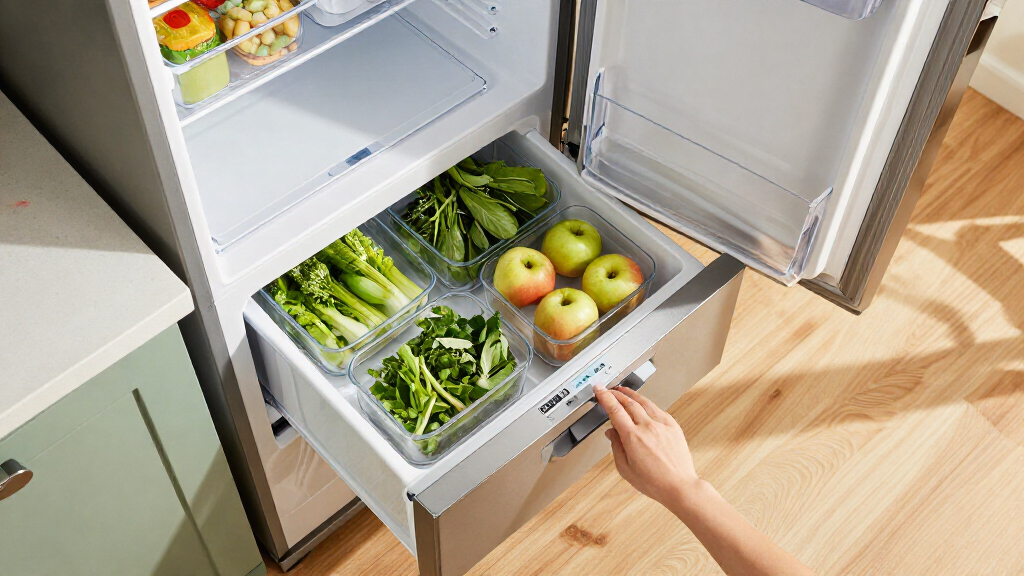
The slider on many refrigerator crisper drawers opens or closes vents to change how much moisture stays inside. Low humidity generally suits many fruits, while leafy greens and other vegetables that wilt easily usually benefit from higher humidity. Settings and labels vary by refrigerator.
The small slider on many refrigerator crisper drawers controls airflow, changing how much moisture the drawer retains and helping tailor storage conditions for different produce. A Hunker report says a low-humidity setting opens the vents, while a high-humidity setting closes them; the distinction matters because fruit and leafy vegetables often keep better under different conditions.
At the low-humidity setting, the drawer vents are open, allowing air and moisture to escape. At the high-humidity setting, the vents close and moisture is retained. Produce releases moisture while stored, so changing the vent position affects the air inside the drawer. The slider regulates humidity through airflow; it does not make the drawer airtight.
Hunker recommends low humidity for many fruits, including apples, pears, peaches, citrus, berries and other stone fruits. The report says fruit releases ethylene gas as it ripens and that allowing air to escape through the vents can help keep fruit fresh. Its guidance is general rather than a guarantee of a particular storage life.
For leafy greens such as spinach, kale and lettuce, the report recommends high humidity, which can help keep leaves from drying and wilting. It also lists water-rich vegetables that can wilt, including cucumbers, eggplants, peppers and carrots. If the drawer has fruit and vegetable symbols, those labels can guide the setting; the article advises checking the refrigerator’s own markings rather than assuming every model works identically.
Humidity Settings Can Reduce Produce Waste
Using the slider to separate produce by its storage needs may help limit wilting, drying and premature spoilage. A refrigerator with two crisper drawers can allow users to keep one at low humidity for fruit and the other at high humidity for vegetables, according to Hunker. That is a practical way to use the controls already built into many refrigerators.
The advice is not a universal storage rule for every item or appliance. Produce condition, refrigerator design and the drawer’s actual vent behavior can differ. Still, understanding that the slider changes airflow gives readers a basis for using the drawer instead of treating it as a simple bin. It can also help explain why a setting that suits greens may not be the best choice for fruit.
Products Worth Considering

eufy Security Video Doorbell E340 Kit with Chime, 2K Resolution and 8GB Local Storage

eufy Security SoloCam E42 4-Camera Kit, 4K Solar Security Cameras with HomeBase 3

Shark Clean & Empty Cordless Stick Vacuum with Auto-Empty System, BU3521
As an affiliate, we earn on qualifying purchases.
How Crisper Drawers Manage Airflow
Crisper drawers are designed to store fruit and vegetables in a separate space inside the refrigerator. In the Hunker account, the slider adjusts vents in that space: opening them lets humid air leave, and closing them retains more moisture. The report connects that difference to the tendency of leafy produce to dry out and the need to let air circulate around many fruits.
The article says many refrigerators have two crisper drawers, which can be set differently. If a refrigerator has only one, Hunker generally recommends using the high-humidity setting for it and storing fruit that needs lower humidity elsewhere, such as on a counter or in a pantry when appropriate. The source cautions that a drawer without a slider may be configured to retain high humidity, with vents that stay closed. It also warns readers not to mistake a fresh-food drawer for a crisper.
“The slider is designed to allow you to set the proper humidity level for storing fruits and vegetables in the crisper.”
— Hunker report
Refrigerator Designs May Differ
The supplied report does not identify a specific refrigerator make or model, and it does not establish that every crisper slider uses the same labels or vent arrangement. Readers should check the markings and instructions for their own appliance. The article’s produce lists are broad guidance; it does not give item-by-item storage times or account for every variety and household condition.
It is also not clear from the source how much any particular setting changes humidity in a given refrigerator. For drawers without a slider, Hunker says they may retain high humidity, but that should not be treated as confirmed for every model. Its suggested lettuce check is an informal test, not a measurement of the drawer’s humidity.
Check Your Drawer Before Setting It
Readers can inspect the crisper’s slider and any fruit-and-vegetable symbols, then consult the refrigerator manual for model-specific instructions. Where there are two drawers, the general approach described by Hunker is to use low humidity for many fruits and high humidity for leafy greens and vegetables prone to wilting. If there is one drawer, the report suggests using high humidity and storing suitable fruit outside the crisper where appropriate.
The source offers no announced follow-up or product change; its practical takeaway is to match the vent setting to the produce and verify how the appliance is labeled. If a drawer has no slider, its actual configuration remains a model-specific question rather than something the report can confirm for every refrigerator.
Key Questions
What does the crisper drawer slider control?
It adjusts the drawer’s vents. Open vents let air and moisture escape for lower humidity; closed vents retain more moisture for higher humidity.
Which setting should I use for leafy greens?
Hunker recommends high humidity for spinach, kale and lettuce because retaining moisture can help keep leaves from drying and wilting. Check your refrigerator’s labels and instructions.
Which setting is generally recommended for fruit?
The report generally recommends low humidity for many fruits, including apples, pears, citrus, berries and stone fruits. Its guidance is broad, and storage needs can vary by item and appliance.
What if my crisper drawer has no slider?
Hunker says such a drawer may be designed to retain high humidity, with vents that stay closed. The source does not confirm this for every refrigerator, so consult the appliance manual or markings.
Source: hunker.com