
TL;DR

Get furniture and decor delivered free with Prime
- Fast, free delivery on millions of items
- Prime Video, Amazon Music and more included
- Member-only deals all year
Hunker has published a DIY project for turning clean, unwanted socks into fabric flowers mounted on dowels. The report describes several rolling methods and says the finished decorations should be kept indoors because moisture can contribute to mold in the fabric folds.
Hunker has published a do-it-yourself project that repurposes old socks as fabric flower decorations, offering a simple alternative to throwing away single or worn-out pairs. The project calls for socks, dowels or similar sticks, and a vase; its report also cautions that the flowers should stay indoors because moisture trapped in the fabric can lead to mold.
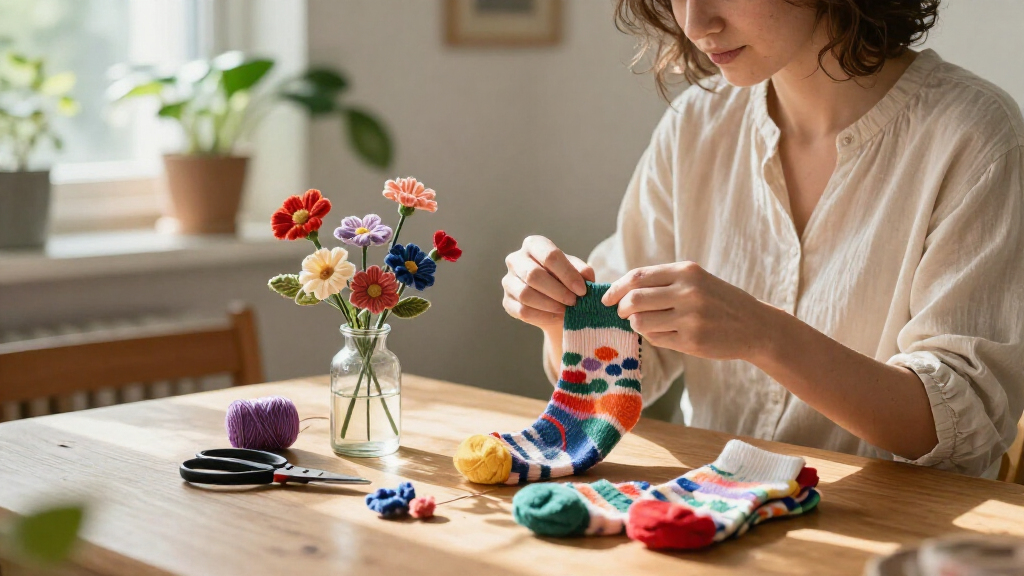
The basic method is to roll a sock into a flower shape, then insert a stick through its center to make a stem. Hunker suggests washing socks that have been stored for a long time and letting them dry before crafting. A dowel can be wrapped in floral tape or painted, though those finishing materials are optional. The source says pop sticks and bamboo skewers can also serve as stems.
Hunker outlines a few ways to form the blooms. One approach starts by flattening and folding a sock lengthwise, then rolling it from the toe and adding twists along the way before tucking the end beneath the layers. A simpler variation rolls from the toe to the cuff, then folds the cuff over the bottom of the roll. Another option is to roll a sock, secure it in the middle with a rubber band, and gently loosen the folds to suggest petals. The report recommends using two socks for larger flowers made with that last method, or pairing two orphaned socks with similar colors and lengths.
Once shaped, the sock flowers can be placed in an old vase. Hunker suggests adding real or artificial greenery and other filler for a fuller arrangement. These are decorative fabric crafts, not outdoor flowers: the report warns that damp conditions can saturate the folds and create a risk of mold.
A Second Use for Single Socks
The project offers readers a small-scale way to reuse socks that might otherwise be discarded, especially pairs left incomplete after one sock goes missing. It also turns basic household materials into a display item without requiring specialized tools. That may appeal to people looking for a low-cost craft or a hands-on activity to do with children, as Hunker says the project can involve kids.
The limits are practical: the result is home decor rather than a durable or weather-resistant product. The source provides no measured estimate of how much fabric or money the project saves, and it does not report testing the flowers for longevity. The value for readers is mainly in the accessible instructions and the option to adapt the folds, colors and display.
Products Worth Considering

Shark PowerDetect Corded Stick Vacuum, Self-Cleaning (Eggplant, HZ4002)

Coway Mighty AP-1512HH(W) Air Purifier, White

Philips Hue Festavia Globe Outdoor String Lights, 32 Bulbs, 91 ft
As an affiliate, we earn on qualifying purchases.
From Laundry Drawer to Vase
Hunker’s report frames the project around orphaned socks taking up drawer space. It briefly refers to a separate laundry hack aimed at preventing missing socks, but the flower craft is a way to reuse socks that are already unmatched or no longer wanted. The article does not provide data about how often socks go missing or the broader environmental impact of this particular reuse idea.
The suggested supply list is short: socks and an equal number of stems for individual flowers, with a vase for display. Floral tape or spray paint can cover plain dowels, and optional filler can make the arrangement look fuller. The instructions describe alternative folding techniques rather than a single required pattern, so the finished shapes may vary with sock size, material and how tightly the fabric is rolled.
“transform them into adorable flowers for your home”
— Hunker
Durability and Materials Vary
Hunker does not specify how long the flowers last, which sock fabrics hold their shape best, or whether a particular adhesive or fastener is needed to keep each bloom attached to its stem. The instructions rely on rolling, tucking and, in one version, a rubber band; the finished flower’s stability may depend on the sock and the way it is assembled.
The report also does not quantify any waste reduction or cost savings. Its warning about mold is a stated practical caution, not a result accompanied by testing details. Readers should treat the project as indoor decor and keep the fabric dry; the source does not establish how the flowers perform in humid rooms or after getting wet.
Try a Fold and Arrange
There is no announced follow-up or scheduled milestone in the source material. The next step for readers interested in the craft is to choose a clean, dry sock and test one of the rolling methods, using a dowel, pop stick or bamboo skewer as the stem. They can then adjust the folds or pair socks to change the bloom’s size and appearance.
After inserting the stem, place the flower in a vase and keep the arrangement away from rain and damp conditions. Hunker’s report presents the project as an adaptable household craft; it does not promise a particular finished shape or lifespan.
Key Questions
What supplies do I need to make a sock flower?
Hunker lists a sock and a stem for each flower. A dowel, pop stick or bamboo skewer can work as the stem; floral tape or spray paint is optional if you want to cover it. A vase is useful for display.
Do the socks need to be clean?
The report recommends washing socks that have been sitting in a musty drawer and letting them dry before shaping them. It does not give separate cleaning instructions for other situations.
How do I make the sock look like a flower?
Hunker describes rolling from the toe, either with twists for a more varied shape or with the cuff folded over the base. Another method secures a rolled sock with a rubber band, then loosens the folds to suggest petals.
Can I display sock flowers outside?
Hunker advises against outdoor display, especially in rainy conditions. Moisture can seep into the fabric folds and contribute to mold, according to the report.
Do I need a matching pair of socks?
Not for every method. Hunker says one sock can be rolled into a flower, while its rubber-band method can use a pair for a larger bloom. It also suggests combining orphaned socks with complementary colors and lengths.
Source: hunker.com