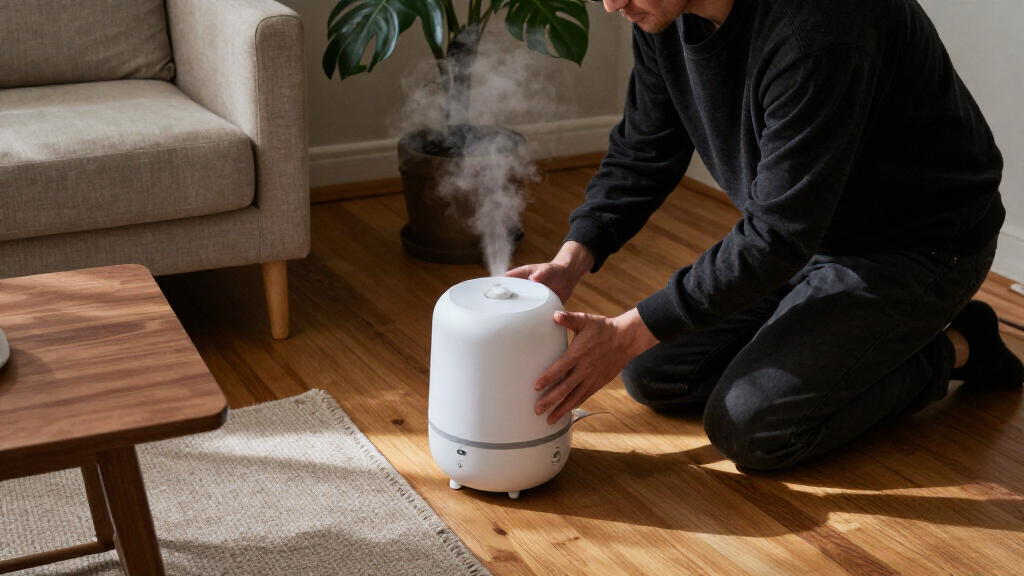

For a living room, the central choice is not simply how much moisture a humidifier can put out. It is whether you prefer an evaporative unit that moves air through a wet filter, or an ultrasonic unit that turns water into a fine, visible mist. Both can help relieve the dryness that comes with heated indoor air, but they behave differently in a shared room where noise, furniture, cleaning, and changing humidity all matter.

Get furniture and decor delivered free with Prime
- Fast, free delivery on millions of items
- Prime Video, Amazon Music and more included
- Member-only deals all year

Lacidoll 8L Top-Fill Cool Mist Humidifier
- ✔ Capacity: 2.1 gallons
- ✔ Stated coverage: 500–800 sq. ft.; also listed as up to 800 sq. ft.
- ✔ Mist output: 300 mL/h

BREEZOME 6L Top-Fill Ultrasonic Cool Mist Humidifier with Humidistat and Essential Oil Tray
- ✔ Tank capacity: 6 liters (1.6 gallons)
- ✔ Coverage: Up to 500 sq. ft.
- ✔ Runtime: Up to 60 hours

Levoit Classic 160 Top-Fill Cool Mist Humidifier, 2.5 L
- ✔ Tank capacity: 2.5 liters
- ✔ Effective range: 219 sq. ft. / 20 m²
- ✔ Maximum runtime: Up to 25 hours on low
Evaporative humidifiers suit households that value steady operation and less risk of excess moisture, and can tolerate fan noise and wick replacement. Ultrasonic models are usually the better fit when quiet operation, compact styling, or adjustable mist matters most. The comparison below focuses on the practical differences; actual coverage, noise, upkeep, and cost vary by model, room layout, and use.
At a Glance
| Criteria | Evaporative humidifier | Ultrasonic humidifier | Winner |
|---|---|---|---|
| Moisture delivery and humidity control | Fan draws air through a damp wick; evaporation tends to slow as room humidity rises. | Vibrations create cool mist; output is often adjustable, but humidity can rise quickly near the unit. | A |
| Noise in a shared room | Fan produces a steady sound that may be noticeable during quiet activities. | Typically very quiet, though some models have water or fan sounds. | B |
| Mineral dust and water quality | Usually does not disperse minerals as visible white dust, though the water tank and wick still need care. | Minerals in untreated hard water may disperse as white dust; distilled or demineralized water can reduce it. | A |
| Cleaning and routine maintenance | Wick needs periodic replacement; tank and base require regular cleaning. | Tank and misting components need frequent cleaning to limit buildup and microbial growth. | Depends |
| Room coverage and placement | Performance depends on unit capacity, airflow, and room layout; airflow can help circulate moisture. | Coverage depends on output and placement; mist can settle on nearby surfaces if directed poorly. | Depends |
| Running and ownership costs | May require ongoing wick purchases; electricity use depends on the fan and model. | May avoid wick purchases, but water treatment and electricity can add costs. | Depends |
| Living-room usability | A practical choice for steady humidification without visible mist. | A strong fit for quiet conversation, television, or a more discreet footprint. | B |
Lacidoll 8L Top-Fill Cool Mist Humidifier
For a living room that needs more than a small bedside unit can provide, the Lacidoll 8L offers the broadest stated reach in this lineup: up to 800 square feet, with a 2.1-gallon tank and three mist levels. Its remote and adjustable humidity control are especially useful in a shared room, where reaching across furniture to change settings can be inconvenient. A timer, sleep mode, and automatic low-water shutoff round out a more hands-off feature set than the Levoit Classic 160 provides.The qualification is that its published performance details are not fully consistent. The description states up to 48 hours of runtime, while product information gives 24 hours; coverage is also described as 500–800 square feet as well as up to 800. We would treat those as estimates rather than planning around the highest figures. BREEZOME gives a clearer long-runtime claim and includes a humidistat, but has lower stated coverage and requires a demineralization cartridge. Compared with both, Lacidoll is the better pick when room reach and remote adjustment come first, not when the most certain runtime figure is the priority.Its filter-free design avoids scheduled filter replacement, though it does not remove the need for routine tank cleaning. At 27 inches tall, it is also notably taller than the Levoit, so placement matters in a living room where the unit will be visible. Choose it for a larger space and a preference for adjustable controls; skip it if you need compact styling or dependable, unambiguous runtime guidance.
Pros:
- Largest stated coverage in this comparison, up to 800 square feet
- Large top-fill tank and three mist settings
- Remote, timer, sleep mode, and adjustable humidity control
- Filter-free design with automatic low-water shutoff
Cons:
- Runtime is listed as both 24 and 48 hours
- Coverage is given as both 500–800 and up to 800 square feet
- Tall 27-inch profile may be harder to place discreetly
Best for: Households seeking broad stated coverage, remote operation, and multiple humidity and mist settings for a larger living room.
Not ideal for: Buyers who need a compact unit or want consistent, clearly stated runtime and coverage figures before choosing.
Bottom line: We rank Lacidoll first for its living-room reach and remote-friendly controls, provided you can accept uncertainty in its stated runtime and coverage.
“We rank Lacidoll first for its living-room reach and remote-friendly controls, provided you can accept uncertainty in its stated runtime and coverage.”
BREEZOME 6L Top-Fill Ultrasonic Cool Mist Humidifier with Humidistat and Essential Oil Tray
The BREEZOME 6L is the balanced middle choice: its stated coverage reaches 500 square feet, and its humidistat can maintain a selected humidity level rather than leaving us to adjust output by feel. The top-fill tank and up-to-60-hour runtime claim also make it appealing for people who want fewer refills. Compared with the Lacidoll, it has a smaller stated coverage area but a longer stated runtime; unlike the Levoit Classic 160, it is intended for substantially more floor area and offers automatic humidity control.Those advantages come with a specific upkeep consideration: BREEZOME lists a demineralization cartridge, so buyers should account for replacement and care rather than assuming this is a no-consumables option. Lacidoll is filterless, which may suit people seeking simpler supply needs, though its runtime information conflicts. The BREEZOME’s 25 dB noise figure and sleep mode make it a reasonable fit for a living room that also serves as a quiet evening space, while its essential oil tray is an optional extra rather than a reason to choose it over coverage and controls.We place it behind Lacidoll because its stated coverage is lower and it lacks the supplied description of remote control. Still, its humidistat and clearer long-runtime claim can be more important than maximum reach for a medium-sized living room. Choose it when you want a larger reservoir and set-and-maintain humidity behavior; pass if you prefer to avoid cartridges or need the widest stated coverage.
Pros:
- 6-liter top-fill tank with up to 60 hours of stated runtime
- Humidistat helps maintain a selected humidity level
- Stated coverage of up to 500 square feet
- Quiet sleep mode and built-in essential oil tray
Cons:
- Requires a demineralization cartridge
- No remote control is listed in the supplied specifications
- Coverage is below Lacidoll’s highest stated figure
Best for: Buyers with medium-to-large living rooms who value a humidistat, a sizeable tank, and a long stated runtime.
Not ideal for: Shoppers who want a filter-free setup, the broadest stated coverage, or remote control.
Bottom line: We recommend BREEZOME for medium-to-large living rooms where a humidistat and long stated runtime matter more than maximum reach or filter-free upkeep.
“We recommend BREEZOME for medium-to-large living rooms where a humidistat and long stated runtime matter more than maximum reach or filter-free upkeep.”
Levoit Classic 160 Top-Fill Cool Mist Humidifier, 2.5 L
The Levoit Classic 160 is the lineup’s compact option, not a substitute for the higher-coverage Lacidoll or BREEZOME. Its stated effective range is 219 square feet, making it better suited to a modest living room, a defined seating area, or a room where a large humidifier would feel intrusive. The 2.5-liter tank runs for up to 25 hours on low, and its top-fill design, wide opening, and simple base make routine cleaning and refilling more approachable than a feature-heavy unit with a larger footprint.Its 25–28 dB operation and ability to turn off lights also suit a living room that doubles as a sleep or relaxation space. A 360-degree nozzle lets us direct mist without moving the whole unit, while automatic shutoff responds when water is low or the tank is removed. Compared with BREEZOME, Levoit is smaller and simpler but offers neither its humidistat nor its stated 500-square-foot coverage. Compared with Lacidoll, it sacrifices reach and remote controls in exchange for a more compact profile and an easier-cleaning design.Water choice is part of ownership here: purified or distilled water is recommended to reduce white dust, and filter cotton may need replacement about monthly depending on water hardness. That is a meaningful contrast with Lacidoll’s filter-free design and BREEZOME’s demineralization cartridge. We would choose Levoit when the room is genuinely small and accessible cleaning is the deciding factor; skip it for open-plan living areas or anyone trying to humidify a broad space with one unit.
Pros:
- Compact 2.5-liter top-fill design
- Up to 25 hours on the lowest setting
- Quiet operation with lights that can be turned off
- Wide opening, simple base, and 360-degree rotating nozzle
Cons:
- 219-square-foot effective range is the smallest in this comparison
- Purified or distilled water is recommended to reduce white dust
- Filter cotton may need replacement about monthly, depending on water hardness
Best for: People with a smaller living room or defined seating area who prioritize quiet operation, accessible cleaning, and a compact footprint.
Not ideal for: Owners of large or open-plan living rooms who need broad coverage or a built-in humidistat.
Bottom line: We choose Levoit for smaller living rooms where quiet, easy-clean design is more useful than the broader coverage of the other two models.
“We choose Levoit for smaller living rooms where quiet, easy-clean design is more useful than the broader coverage of the other two models.”
As an Amazon Associate we earn from qualifying purchases.
Key Differences
The most meaningful difference is how the two types respond to a living room’s changing conditions. An evaporative unit relies on air moving through a wet wick, and evaporation generally slows as the air gets more humid. That can make its output feel steadier and reduce the chance of pushing humidity too high. An ultrasonic model releases mist directly, often with a control for output. That gives you more immediate adjustment, but the mist can collect on nearby surfaces if the unit runs too hard or sits too close to furniture.
That behavior also shapes the daily experience. The evaporative fan is more audible, while an ultrasonic unit is often quiet enough to fade into background activity. In return, ultrasonic users may need to pay closer attention to water minerals, cleaning, and room humidity. Evaporative owners face their own upkeep: wicks need replacement, and any humidifier’s tank and water-contact surfaces need regular cleaning. The better choice comes down to which inconvenience is easier for your household to manage.
Neither type automatically suits every living room. A large open-plan area may need more output than a small unit can provide, while a compact room can become damp if a powerful model runs continuously. Check the manufacturer’s coverage guidance, use a separate hygrometer if the humidifier does not measure humidity reliably, and avoid directing mist or airflow at electronics, walls, or wood furniture.
Detailed Comparison
Moisture delivery and humidity control (Evaporative humidifier wins — moderate)
Evaporative wins by a moderate margin for steady, forgiving operation. Its output depends on evaporation, which tends to slow as the surrounding air becomes more humid. That does not replace a humidity monitor or good operating habits, but it can make the unit less prone to raising humidity aggressively. Ultrasonic models usually offer more direct control over mist output, which is helpful when you want a quick adjustment. The tradeoff is that a high setting can create dampness near the unit before the room’s average humidity changes much. Choose A for steady background use; choose B if adjustable output is your priority.
Ultrasonic wins, usually by a moderate to major margin. With no large fan driving air through a wick, many ultrasonic models run quietly, making them less intrusive during conversation, television, or reading. Evaporative models need airflow and produce fan noise; the sound may be unobtrusive in a busy room but noticeable when the room is quiet. Exact noise varies, so check model-specific ratings and user guidance. If quiet is a firm requirement, B is the safer category bet.
Mineral dust and water quality (Evaporative humidifier wins — moderate)
Evaporative wins by a moderate margin for households with hard tap water. Its wick generally retains minerals rather than sending them into the air as a visible plume. Ultrasonic units can disperse dissolved minerals, which may leave white dust on nearby surfaces. Using distilled or demineralized water can reduce that issue, though it adds expense and supply planning. If you want to use ordinary tap water and avoid dust, A is usually easier; if you are willing to manage water quality, B remains viable.
Cleaning and routine maintenance (moderate difference)
There is no universal winner; the burden is different. Evaporative units need tank and base cleaning plus wick inspection and replacement as directed. Ultrasonic units also need regular tank cleaning, and their water-contact components may collect mineral scale that calls for careful cleaning. A wick is a predictable consumable, while an ultrasonic model can require more attention to water deposits and water choice. For a household that dislikes replacement parts, B may appeal; for one that wants to avoid mineral residue, A may be easier. Follow the specific manual for either type.
Room coverage and placement (major difference)
This is model-dependent, not a reliable category win. Both types range from small units to models intended for larger spaces, and advertised coverage is only useful when it matches the room’s real size and layout. An evaporative fan moves air through the unit, while an ultrasonic plume can be aimed, but neither feature guarantees even humidity across a large or divided living area. Keep the humidifier on a stable surface with clearance, away from electronics and moisture-sensitive items. Compare output and room-size guidance rather than choosing by type alone.
Running and ownership costs (moderate difference)
Neither category is automatically cheaper over time. An evaporative model can add the recurring cost of replacement wicks. An ultrasonic model may avoid that part, but hard-water users may spend on distilled water or descaling supplies. Electricity use varies with design, output, and operating time, so compare the specifications for the exact models rather than assuming one technology always uses less. B can be better value when quiet operation matters and water is inexpensive; A can be better value when mineral-free operation with tap water matters and wick costs are modest.
Living-room usability (Ultrasonic humidifier wins — minor)
Ultrasonic wins slightly for comfort and discretion; evaporative wins for low-fuss background use. A quiet ultrasonic unit is less likely to compete with conversation, and many models have a compact footprint. But visible mist can make the appliance more noticeable, and poor placement can dampen surfaces. An evaporative unit may be bulkier or audible, yet it does not send a visible plume into the room. For a quiet sitting area, B usually feels more convenient; for continuous use where a visible plume is unwelcome, A may fit better.
Evaporative humidifier: Pros and Cons
Pros:
- Evaporation tends to slow as room humidity rises, supporting steadier output.
- Less likely to spread visible mineral dust when used with hard water.
- No visible mist plume to manage around furniture or electronics.
Cons:
- Fan noise can be noticeable during quiet activities.
- Wicks require periodic replacement and add an ongoing cost.
- A fan-based unit may be less appealing when a compact, discreet appliance is the goal.
Ultrasonic humidifier: Pros and Cons
Pros:
- Often quiet, which suits conversation, television, and reading.
- Mist output is commonly adjustable for more immediate control.
- Many models have a compact design and do not use a replaceable wick.
Cons:
- Hard tap water can leave mineral dust on surfaces.
- Needs regular cleaning, with attention to scale and water quality.
- Mist can dampen nearby surfaces if output or placement is poorly managed.
Who Should Choose What
Choose Evaporative humidifier if:
- You want steady humidification and would rather not manage a visible mist plume.
- Your tap water is hard and you do not want to buy distilled water to limit white dust.
- A modest fan sound is acceptable, and you are comfortable replacing a wick on schedule.
Choose Ultrasonic humidifier if:
- Quiet operation matters more than the sound of a fan, especially during television or conversation.
- You want adjustable mist output and can monitor room humidity and nearby surfaces.
- You have access to suitable low-mineral water or are willing to manage water quality and cleaning.
Skip both if: Neither type is a good fit if you cannot clean the tank and water-contact parts regularly, or if the room already has excess humidity, condensation, or persistent dampness. Address the moisture problem first rather than adding humidity.
Value for Money
Paying more for an ultrasonic model is worthwhile when its quieter operation solves a daily annoyance, or when a particular model offers useful controls and adequate coverage. It is not automatically better value just because it is quieter: hard-water households may face ongoing distilled-water costs, and careful cleaning remains part of ownership.
An evaporative model can deliver better value when you are comfortable with fan noise and the cost of replacement wicks is lower than the water-management expense of an ultrasonic unit. Compare the total ownership picture for the exact models: purchase price, wick or water costs, cleaning supplies, and electricity. For most living rooms, pay extra for a feature you will use—quietness, dependable humidity control, or coverage—not for a technology label alone.
Final Verdict
For the average living room where mineral dust and steady operation matter, choose an evaporative humidifier. Its fan is the main compromise, but it is usually the more forgiving option for households using tap water and seeking background moisture without a visible plume. Choose an ultrasonic model instead if a quiet room is the priority and you are prepared to manage water quality, cleaning, and placement.
The deciding factor is not which type can produce mist; both can. It is which routine you will tolerate: fan noise and wick replacement, or quiet operation paired with closer attention to minerals and surfaces. Before buying either, match the unit’s stated coverage to the room, check whether it has a useful humidistat, and plan to keep indoor humidity at a sensible level.
Frequently Asked Questions
Which type is quieter for a living room?
Ultrasonic humidifiers are generally quieter because they do not rely on the same kind of fan-driven airflow as evaporative models. A specific unit can still make water or mechanical sounds, so check model-level noise information if silence is important.
Will an ultrasonic humidifier leave white dust?
It can. Minerals in hard tap water may be dispersed with the mist and settle as white dust. Distilled or demineralized water can reduce this, though it adds an ongoing cost. Evaporative models generally retain more minerals in the wick.
Which humidifier type is safer around wood furniture?
Neither type should be placed where moisture can reach wood. Ultrasonic mist can settle on nearby surfaces if directed poorly, while any humidifier can raise room humidity too far. Keep the unit clear of furniture and use a hygrometer or reliable humidistat to monitor conditions.
Do living rooms need an evaporative or ultrasonic humidifier?
Choose by room conditions and household priorities rather than room label. Evaporative models suit users who prefer steady output and want to limit mineral dust; ultrasonic models suit users who prioritize quiet and can manage water quality. For a large or open-plan room, check rated coverage and output first.